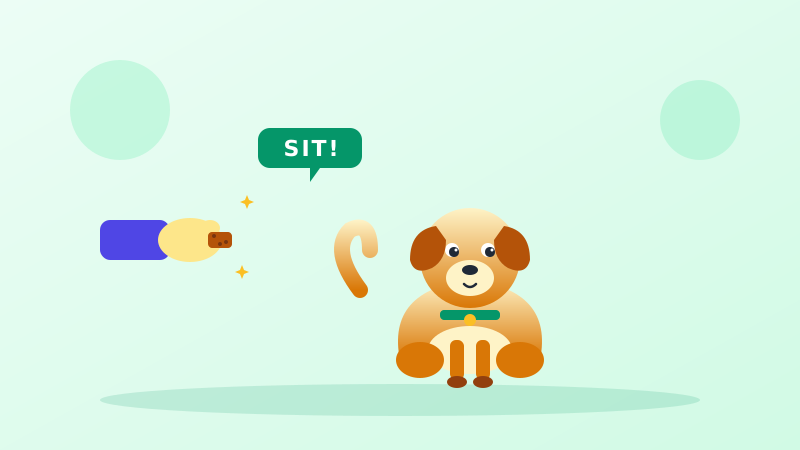
Key principle: Dogs jump because it works. They get attention, eye contact, and physical contact, which are exactly what they want. Teaching a reliable alternative behavior is far more effective than punishing the jump itself.
Your doorbell rings, your guest steps inside, and before anyone has a chance to say hello, your dog launches into the air, paws hitting chest or shoulders, tail wagging with joyful enthusiasm. For your dog, this is a perfectly reasonable greeting. For your guest, especially one in work clothes or carrying something, it can range from mildly awkward to genuinely unsafe. Jumping up is one of the most common and most persistent behavior problems in pet dogs, and it is also one of the most treatable, provided the approach is consistent and grounded in how dogs actually learn.
This guide walks through why dogs jump, why common responses often make the problem worse, and a step-by-step positive-reinforcement protocol that replaces jumping with a calm, reliable greeting behavior. The methods here align with force-free training principles endorsed by the American Veterinary Society of Animal Behavior and professional organizations such as the Karen Pryor Academy and the International Association of Animal Behavior Consultants.
Why Dogs Jump on People
Jumping is not dominance, rudeness, or poor character. It is a greeting behavior with a clear evolutionary and developmental basis.
Puppies greet adult dogs by approaching the face and muzzle, often licking at the corners of the mouth. This behavior is reinforced in early life because it elicits attention, regurgitation of food in wild settings, and tolerance from adult dogs. When puppies are then raised around humans, they naturally try to reach the human face in the same way. Because human faces are several feet above the ground, reaching them requires a vertical leap.
This baseline tendency gets strengthened every time jumping produces a response, and almost any response counts as a reward. Eye contact, being spoken to (even scolded), being touched (even pushed away), and laughter or startled reactions all tell your dog that jumping produces interesting human behavior. Over weeks and months, jumping becomes the default greeting strategy because it reliably generates engagement.
Why Common Solutions Fail
Understanding why certain popular approaches do not work is half the battle, because many households unintentionally reinforce jumping through these responses.
| Common Response | Why It Fails |
|---|---|
| Pushing the dog off with hands | Provides physical contact, which is often the reward the dog was seeking |
| Yelling "down" or "off" | Provides attention and excitement, which reinforces the jump |
| Kneeing the dog in the chest | Can cause injury, damages trust, and does not teach an alternative behavior |
| Stepping on the dog's back feet | Painful and can damage the human-dog bond; does not generalize |
| Sporadic correction only with guests | Inconsistency confuses the dog and slows learning |
| Letting family jump but scolding for guests | Dog cannot distinguish contexts on their own; learns to jump selectively at best |
The pattern that emerges is simple. Responses that provide any kind of attention tend to reinforce jumping, and punishment-based responses tend to damage the relationship without teaching anything in its place.
The Core Training Principle
The most effective way to stop jumping is to teach an incompatible replacement behavior, typically "four paws on the floor" or a reliable sit, and to ensure that this alternative is the behavior that actually gets the dog what they want: attention and interaction.
This is often summarized as: jumping earns nothing, four-on-the-floor earns everything. The dog is not being punished; they are simply being shown that the old strategy no longer pays off and that a new strategy pays generously.
Step-by-Step Training Protocol
Step 1: Teach a Solid Sit
Before working on guest greetings, make sure your dog reliably sits on cue in quiet environments. Use small, high-value treats and reward generously. Practice in short sessions of three to five minutes, multiple times per day. A sit that works in the kitchen when nothing interesting is happening is the foundation for a sit that works at the front door when a guest arrives.
Step 2: Practice Calm Greetings With Household Members
Household members should begin greeting the dog only when four paws are on the floor. If the dog jumps, silently turn away, withdraw hands, and do not make eye contact. The moment all four feet are down, turn back and calmly pet or treat the dog.
Repeat consistently. Within days most dogs begin to understand that jumping makes the human disappear and that standing still or sitting brings them back. Consistency across every single household member is essential. A single person who still permits jumping can undo weeks of work.
Step 3: Introduce the "Greet" Cue
Once the dog is reliably keeping paws down during household greetings, add a verbal cue such as "say hi" immediately before giving the greeting reward. Over time this cue becomes a clear signal that it is time to greet calmly, which gives you a predictable control structure.
Step 4: Practice With a Helper
Recruit a friend who understands the plan. Have them approach the door while you keep the dog on a short leash several feet back. Ask for a sit. If the dog holds the sit as the helper enters, the helper calmly approaches and delivers a treat or quiet praise. If the dog breaks the sit and jumps, the helper immediately turns and walks out. Reset, try again.
Short, repeated sessions are more effective than long ones. Five to ten repetitions per session, a few sessions per week, and steady progress will follow.
Step 5: Generalize to Real Guests
Real guests are harder because they are less predictable and the environmental excitement is higher. Set guests up for success by:
- Texting or calling ahead to explain the plan in one sentence ("please ignore the dog until she is sitting calmly").
- Having the dog on a leash attached to you or to a fixed anchor for the first minute of the visit.
- Keeping high-value treats near the door to reward calm behavior in real time.
- Stepping on the leash to prevent jumping if needed, without any verbal correction.
Step 6: Manage the Environment During Training
Until the new behavior is reliable, manage situations you cannot fully train. A baby gate, exercise pen, or leash tether gives you a reliable way to prevent rehearsals of the old behavior, which is critical because every successful jump reinforces the habit. See our dog care library for more on environmental management.
Special Cases: Large Dogs, Seniors, and Visitors Who Encourage Jumping
Large and Powerful Breeds
For breeds like Labradors, German Shepherds, Great Danes, and Rottweilers, jumping is not just an etiquette issue; it can knock over children, elderly guests, and people with balance issues. Prioritize leash management and a reliable sit before any guest arrives. Never allow a large dog to "practice" jumping on anyone, including family members who do not mind, because the dog cannot generalize who is or is not acceptable to jump on. Our large breed guides have breed-specific tips.
Senior Dogs With Long Jumping Histories
Older dogs with long-established jumping habits take longer to retrain, but the principles are identical. Expect four to eight weeks of consistent practice rather than a few days. Never assume it is too late; older dogs learn new associations throughout their lives.
Visitors Who Encourage Jumping
Some guests genuinely enjoy an enthusiastic canine greeting and will say "it's okay, I don't mind." The dog cannot parse that nuance. If you want jumping eliminated, it needs to be eliminated across all humans. A simple, polite sentence ("we're training her not to jump, can you wait until she sits?") is usually enough to get cooperation from most guests.
Caution: Never use aversive tools such as shock collars, spray collars, or prong collars to address jumping. These approaches can suppress the visible behavior while increasing anxiety around people, which can create more serious problems including reactivity and fear-based aggression.
Troubleshooting Common Setbacks
The dog sits, then jumps as the guest reaches down.
This means the guest's approach is still too exciting. Back up a step: the guest should stop approaching if the dog breaks the sit, and only resume once the sit is restored. The dog learns that jumping freezes the interaction, while sitting makes it progress.
The dog is fine with some people but jumps on others.
Children, men with deep voices, people in uniforms, and visitors carrying bags often produce more excitement. Practice deliberately with these specific categories of people, using helpers who fit the profile.
Progress is happening at home but falls apart in public.
Public environments have more distractions and higher arousal. Lower your criteria in those settings, reward more frequently, and build up gradually. Training does not generalize automatically from the living room to the sidewalk.
When to Call a Professional
Consider hiring a certified positive-reinforcement trainer or a veterinary behaviorist if:
- The jumping is accompanied by growling, snapping, or bite inhibition failures.
- The dog shows anxiety, stress signals, or arousal-based behaviors that go beyond simple excitement.
- You have trained consistently for several weeks without any meaningful improvement.
- Household members cannot agree on or follow a consistent approach.
Look for credentials such as CPDT-KA, KPA-CTP, CBCC-KA, or board-certified veterinary behaviorist (DACVB). These certifications indicate training grounded in modern behavior science rather than outdated dominance-based methods.
Frequently Asked Questions
How long does it take to stop a dog from jumping?
With consistent daily practice and full household cooperation, most dogs show meaningful improvement within two to four weeks and reliable greetings within two months. Dogs with longer jumping histories or higher arousal may take longer.
Can I use a spray bottle to stop jumping?
Spray bottles are not recommended. They can work in the short term for some dogs but often create association issues with people, create fear around the training context, and do not teach an alternative behavior. Positive-reinforcement replacement training is consistently more effective and more humane.
My puppy just started jumping. Should I wait or start training now?
Start now. The longer jumping is practiced successfully, the harder it is to replace. Puppies learn the replacement behavior especially quickly because they have fewer reinforcement repetitions to unlearn. Our puppy care guides cover early training fundamentals.
What if I have multiple dogs?
Train each dog individually before attempting guest greetings together. When practicing with guests, tether the less-trained dog or manage them behind a gate while you work with the other. Once both dogs are reliable individually, practice with them together.
Is jumping ever acceptable?
Some owners teach a cued jump ("up!") for play, sports, or greeting on specific invitation. This is fine as long as the dog clearly understands that the jump only happens on cue, and the default greeting is always four paws on the floor.
Disclaimer: This training guide is educational. For dogs with aggression, severe anxiety, or complex behavior issues, consult a certified behavior professional or veterinary behaviorist.